
The six cognitive areas
Recognisable activities and defined goals
Explore the pathwayProject in development · Pathways defined by the professionalRecognisable activities and defined goals
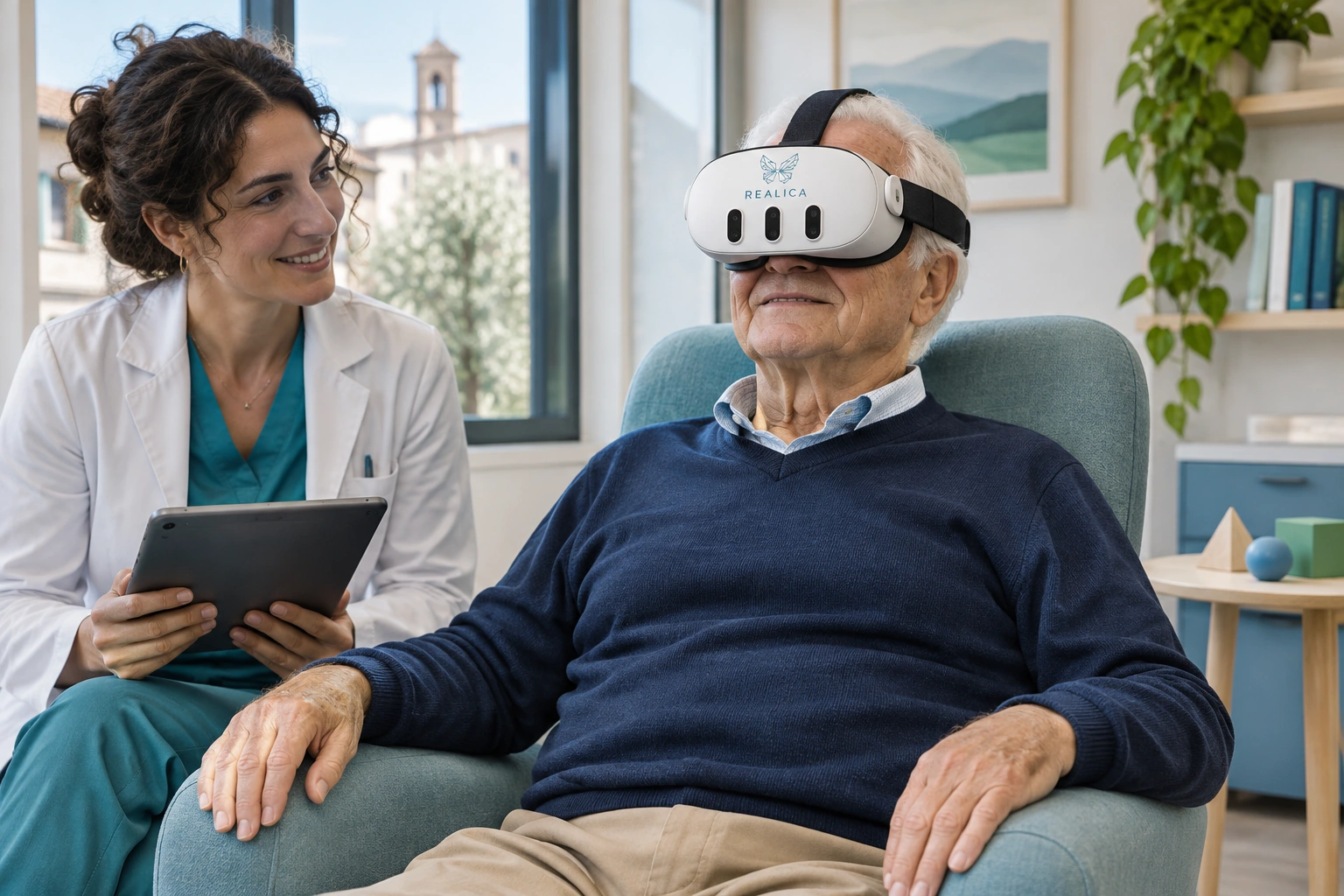
LUCIDA VR is designed to offer multidomain activities within an immersive environment. The professional selects goals and balances demands, difficulty and support. A task may involve several functions simultaneously: the areas help organise the programme, without representing independent compartments.
Six cognitive areas.
Individual goals.
Explore the areas of activity planned for LUCIDA VR.

Memory
Activities may involve recognising objects presented earlier, remembering associations or reconstructing a short sequence. The programme distinguishes learning from recall and considers the assistance required. Assisted recognition is not interpreted as equivalent to spontaneous recall.
Attention
Tasks may involve identifying a stimulus among distractors, retaining an instruction for a short interval or responding to a specific signal. The number of elements, visual complexity and pace are adjusted to prevent perceptual load from obstructing understanding of the request.
Language
Naming, matching words and objects, semantic categorisation and understanding instructions are examples of activities. Selection must be consistent with language, familiarity with the stimuli and communication abilities. Difficulty with expression must not be confused with a lack of understanding.
Orientation
Activities may involve understandable temporal and spatial references: reading a clock, ordering times of day or identifying a position. Stimuli are selected according to the person's experiences and knowledge.
Executive functions
Organising a sequence, applying a rule, selecting a relevant response or changing a strategy involves planning and control processes. Progression must remain compatible with understanding of the task and the level of fatigue.
Visuospatial skills
Assembling shapes, positioning elements and recognising spatial relationships are examples planned within the project. Motor demands and the reliability of interaction must be considered when interpreting performance.
How to interpret the results
Accuracy, response time, errors and assistance received describe different aspects of performance. A correct response with assistance requires a different interpretation from an independent response. The professional assesses all the data and their clinical significance; the activities do not, on their own, constitute validated diagnostic tests.
Explore the clinical pathway
In the same area