
Cognitive decline, MCI and early-stage Alzheimer's disease
The clinical picture comes before the choice of tool
Explore the pathwayProject in development · Pathways defined by the professionalThe clinical picture comes before the choice of tool
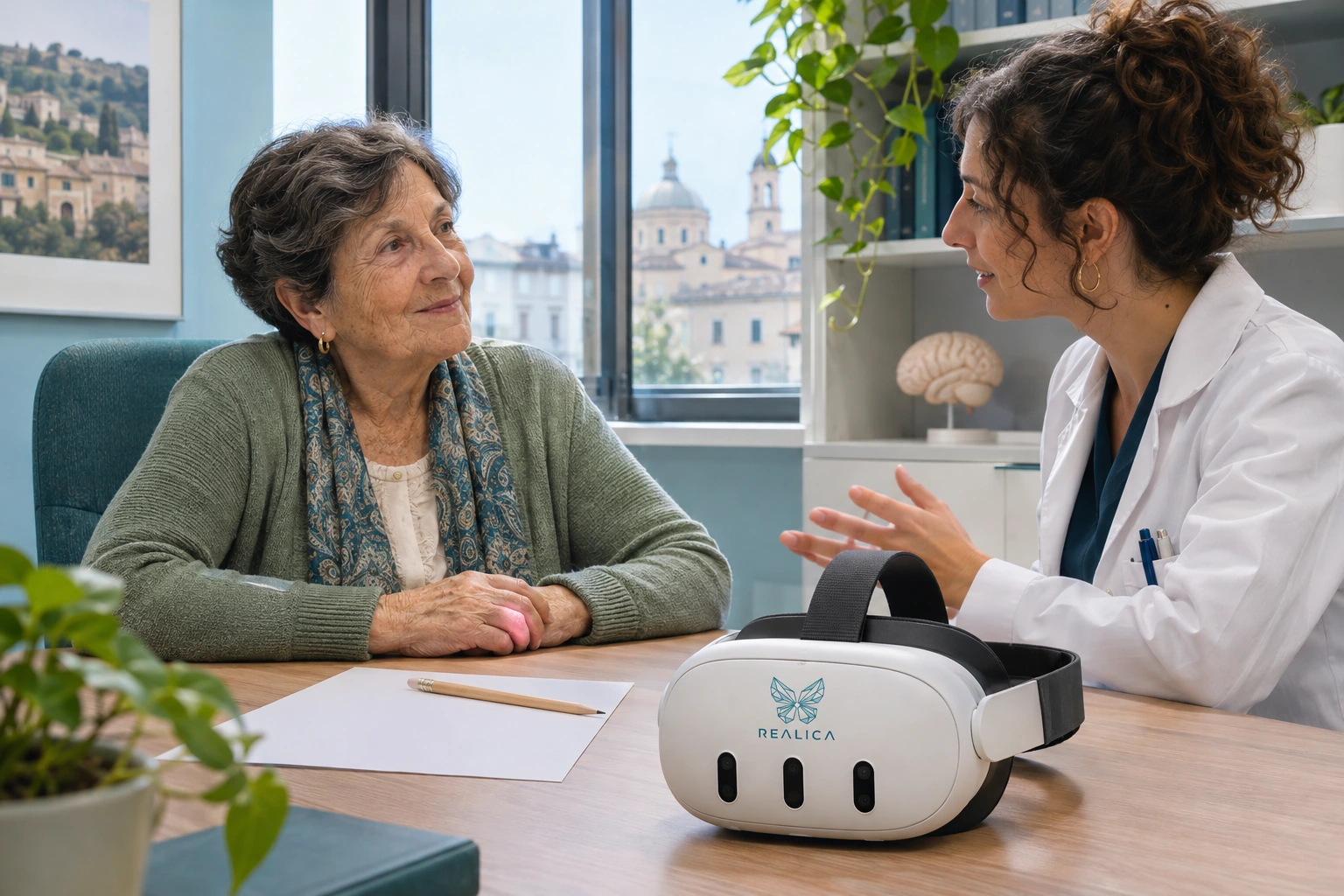
Mild cognitive impairment, or MCI, describes a condition in which cognitive difficulties exceed those expected for a person's age, while independence in everyday life is largely preserved. It is not the same as a diagnosis of dementia and does not necessarily progress to Alzheimer's disease. Defining the clinical picture requires clinical assessment and monitoring over time. [11]
In early-stage Alzheimer's disease, the care programme also considers the impact of difficulties on everyday life, the support available and the family's needs. A diagnosis does not automatically determine suitability for an immersive experience.

Assessment for a cognitive pathway
The professional combines medical history, neuropsychological assessment and information about everyday functioning. They also consider understanding of instructions, visual and hearing abilities, motor skills needed for interaction and tolerance of the headset. These elements help distinguish a cognitive difficulty from difficulty accessing the task.
A screening test score does not automatically translate into an exercise level. Performance must be interpreted in the light of the person's profile, context and goals. The programme may require simpler demands, more time or different support, rather than being reduced to a uniform progression in difficulty.
The planned role of LUCIDA VR
LUCIDA VR offers an environment for guided cognitive activities and observation of the pathway. Its development considers the possibility of selecting relevant tasks, adjusting assistance and reviewing the programme based on feedback from the clinician and the person.
The aim is to offer a tool to be assessed within care, with attention to participation and continuity. Use in different populations, such as people experiencing the effects of stroke or traumatic brain injury, requires specific goals and verification and cannot automatically be equated with use in MCI.
Benefits to demonstrate and limitations to clarify
More accurate performance in an exercise may reflect task learning and familiarity with the system. Demonstrating a clinical benefit requires independent measures, functional assessments and adequate observation periods. Diagnosis and treatment decisions remain the professional's responsibility.
Discover how the programme is defined
In the same area