
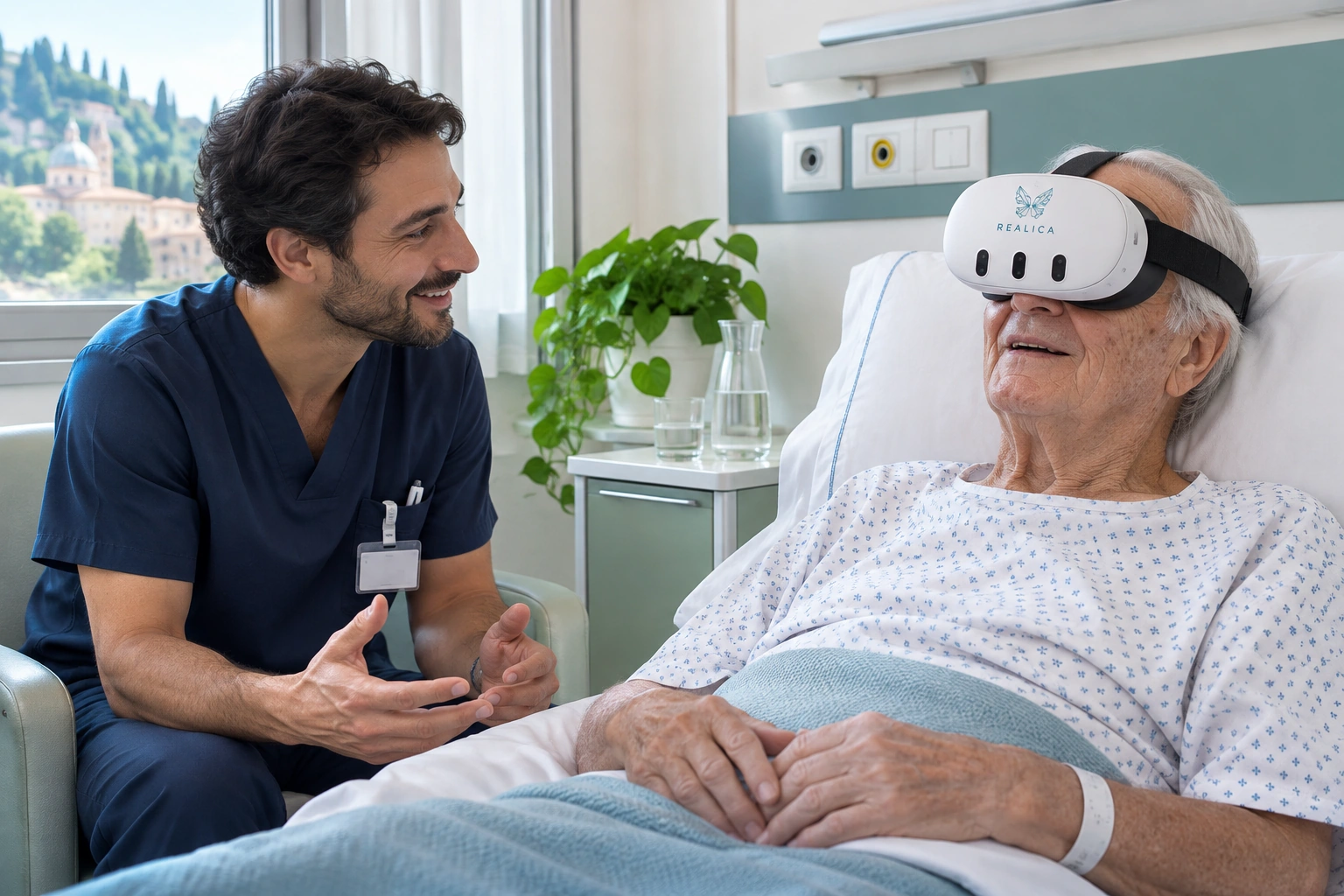
Prolonged hospital stays and care for people living with frailty
Beyond the individual procedure
Explore the pathwayBeyond the individual procedure
A prolonged hospital stay can involve reduced usual activities, repetitive days and difficulty maintaining familiar points of reference. For a person living with frailty, symptoms, tiredness and care needs are intertwined with the wish to retain opportunities for choice.
In this context, REALICA may be considered as a limited comfort intervention. The aim is to offer a welcomed experience at selected moments, without adding demanding tasks. The choice takes account of what the person wants and tolerates at that stage of the pathway.

Care situations to consider
The experience may be offered during periods of waiting or rest while awake, or alongside bedside care, venous access and wound dressings, when conditions allow. If the main need is pain management for a specific procedure, the area dedicated to procedural anxiety and pain is also relevant.
During repeated treatments, continuation requires reassessment: acceptance on one day does not determine suitability on subsequent days. Fatigue, symptoms, mental clarity and the desire for interaction may change.
Frailty and individual choice
The professional considers the ability to communicate, orientation, sensory impairments, motor limitations and comfort in the planned position. Difficulty expressing a need requires particular attention. The practitioner must be able to observe the person and recognise signs of discomfort.
In the presence of acute changes in mental state, unexplained agitation or unstable conditions, clinical assessment takes priority. VR is not presented as a treatment for delirium or clinical instability.
Assessing the meaning of the experience
Enjoyment may be a relevant outcome for a comfort intervention, but must be distinguished from a therapeutic effect on a condition. It is useful to document actual duration, tolerability, requests to repeat the experience and reasons for stopping. Collecting this information allows the approach to be adapted and avoids routine use without an agreed purpose.
Consider a comfort pathway on your ward
In the same area